
Blog
Yoga Cues Explained: What They Mean and Why They Work
One phrase from your teacher and suddenly a pose that felt wrong for weeks makes complete sense. That is what a good yoga cue does. It bridges the gap between what your body is doing and what it actually needs to do.
This article is written from a yoga teaching perspective, drawing on personal experience in studio and online classes. The research referenced covers motor learning and movement science.
Yoga cues are the instructions, adjustments, and guidance that help students move safely and mindfully through their practice. They’re not just fancy words teachers throw around, they’re carefully chosen tools that bridge the gap between intention and action. When you understand how cues work, yoga stops being a guessing game and becomes an intentional, empowering experience.
The Three Ways Teachers Guide a Room
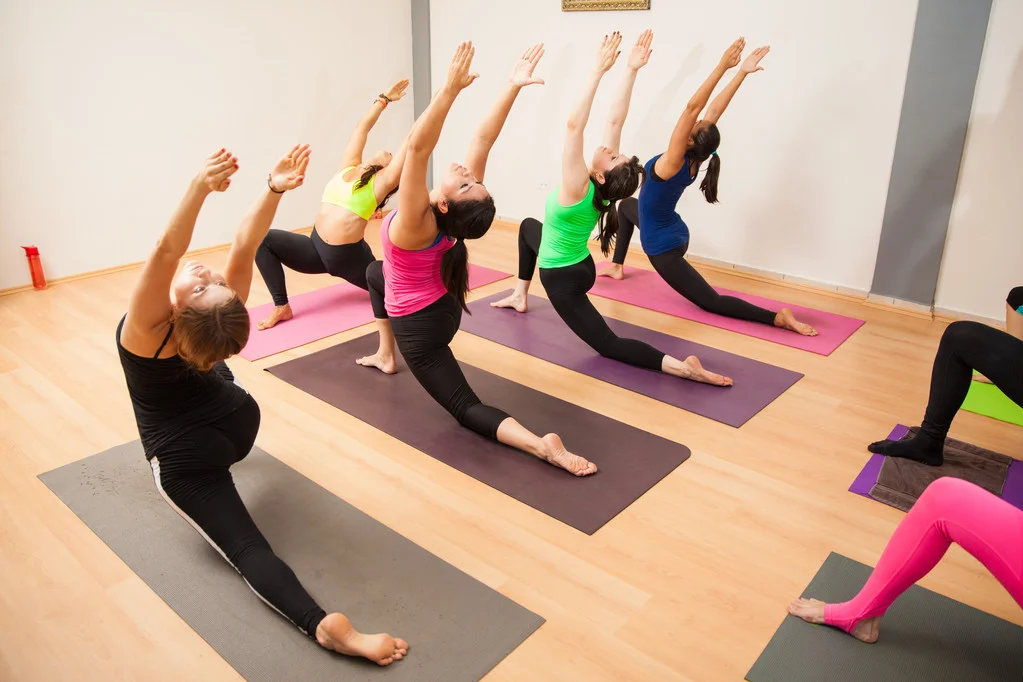
Visual cues happen when your teacher demonstrates a pose or uses their hands to show direction. When you see the shape of Warrior II, your brain creates a movement blueprint to follow.
However, here’s the tricky part: you shouldn’t try to make your body look exactly like your teacher’s body. We all have different bone structures, muscle lengths, and flexibility levels. A good visual cue shows you the essence of the pose, not a rigid template.
Verbal cues are the spoken instructions that guide you through class. These range from directional cues like “bend your right knee” to alignment cues like “lengthen through your spine.” The best verbal cues create sensory experiences in your mind that your body naturally wants to follow, a principle that runs through everything from beginner classes to Ashtanga yoga practice.
Tactile cues are gentle hands-on adjustments where a teacher physically guides your body. A light touch on the shoulder blade, a hand on the hip to square it in Warrior II — these communicate in seconds what verbal language sometimes can’t. Every reputable yoga teacher asks for consent before touching students.
What Your Teacher Actually Means When They Say These Things
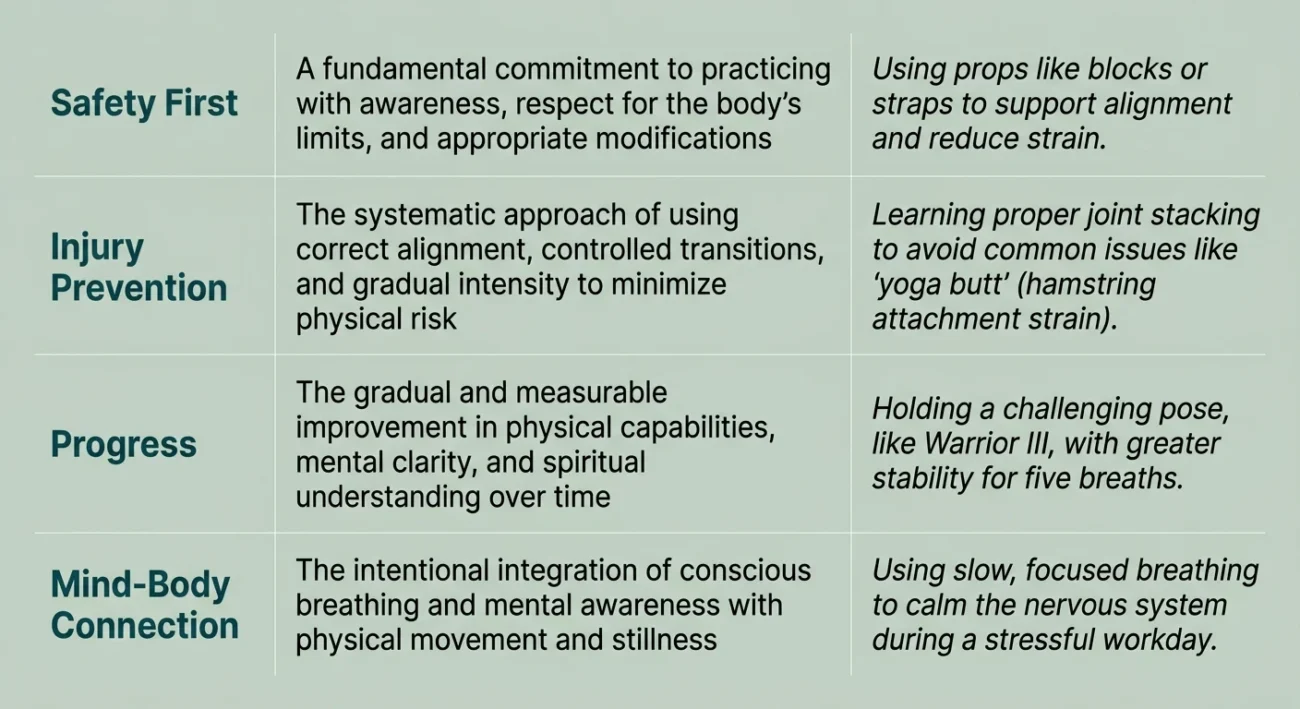
“Engage your core” This is asking for about 30% activation of your deep abdominal muscles. Not sucking in, not a hard belly. Think of the gentle internal engagement right before a sneeze. You should still breathe fully and comfortably.
“Find your edge” That sweet spot where intensity is present but pain is not. On a scale of one to ten, you are looking for a six or seven. Your edge changes with sleep, stress, and time of day. Monday’s edge and Friday’s edge will not always be the same.
“Microbend your knees” A tiny, almost imperceptible softening of the knee joint in standing poses and forward folds. You cannot see it from the outside. This single cue protects the knee from hyperextension and prevents long-term joint damage.
Why Some Cues Click and Others Fall Flat
Research by Gabriele Wulf and colleagues consistently shows that external focus cues outperform internal focus cues for movement quality. Instead of saying “squeeze your glutes,” a teacher gets better results with “press your hips toward the ceiling.” Your brain processes the intended outcome more efficiently than individual muscle instructions.
Imagery works the same way. When a teacher says “grow tall like a mountain,” your nervous system responds to that image in ways pure anatomy cannot reach. A 2018 study in the Journal of Bodywork and Movement Therapies found that metaphorical cues increased both muscle activation and postural stability.
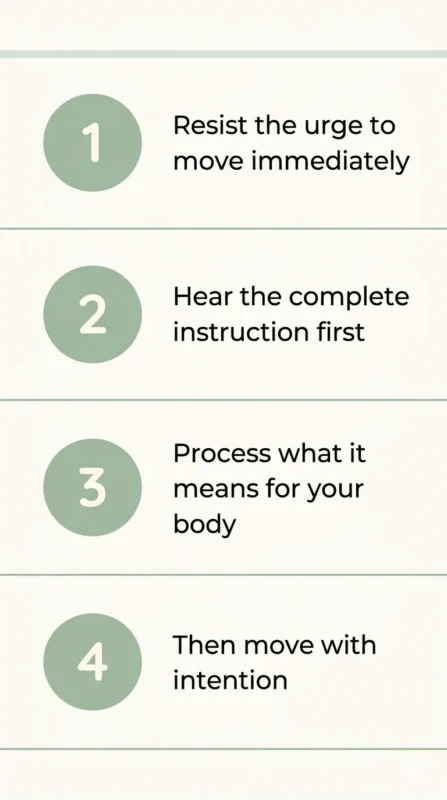
Timing matters too. Your brain needs three to five seconds to process and apply a new instruction. Teachers who fire cues without pause create cognitive overload, students stop listening entirely.
Adapting Yoga Cues to Your Unique Body Structure
Standard cues don’t work for everybody. Here’s what affects how you should interpret instructions:
Body Proportions Matter:
- Someone with long femurs and a short torso needs different alignment in forward folds
- A person with naturally loose ligaments requires different cues than someone with tight connective tissue
- Your arm and leg length ratios affect how poses should look on your body
Honor Your Injury History:
- Shoulder injuries may require wider hand placement in downward dog, and understanding how your body moves is a big part of what body sensing is about.
- Knee issues might need different angles in lunges
These aren’t modifications because you’re doing it wrong, they’re intelligent adaptations, the same principle behind rehabilitative care and movement recovery.
How to Use Yoga Cues When You Practice Alone
Visual Feedback Tools:
- Set up your mat where you can see yourself in a mirror occasionally
- Use periodic visual checks to understand whether your internal sense matches reality
Record Your Practice:
- Use your phone propped on a chair every few weeks
- Watch the footage later with the sound off to focus on alignment
- You’ll be surprised by patterns you can’t feel in the moment
Build Your Personal Cue Library:
- When you hear an instruction that makes a pose click, write it down immediately
- Use your own words to describe what worked
- These personally resonant cues become your most valuable tools
What Every Yoga Teacher Should Know About Cueing
Master the Art of Layering:
- Foundation layer: Start with basic cues (“Step your right foot forward between your hands”)
- Alignment layer: Add refinements for intermediate students (“Align your right knee over your right ankle”)
- Advanced layer: Offer deeper explorations (“Can you find more external rotation in your right hip?”)
Practice Responsive Cueing:
Watch your students and cue what you actually see. If shoulders are creeping toward ears, address that immediately. If everyone is holding their breath, remind them to breathe.
This is the difference between teaching a class and teaching the people in it.
References
Wulf, G., & Lewthwaite, R. (2016). Optimizing performance through intrinsic motivation and attention for learning: The OPTIMAL theory of motor learning. Psychonomic Bulletin & Review, 23(5), 1382–1414.
Wulf, G. (2013). Attentional focus and motor learning: A review of 15 years. International Review of Sport and Exercise Psychology, 6(1), 77–104.
Sullivan, M. B., et al. (2018). Yoga therapy and polyvagal theory. Frontiers in Human Neuroscience, 12, 67.
Schmalzl, L., Powers, C., & Henje Blom, E. (2015). Neurophysiological and neurocognitive mechanisms underlying the effects of yoga-based practices. Frontiers in Human Neuroscience, 9, 235.