
Blog
What Causes an Outie Belly Button?
One of such body parts, which you may not really consider much, is your belly button that carries a very interesting story about the early years in your life. The majority of the people possess what we describe as an innie belly button, whereas a small number of people have an outie belly button that protrudes out of the stomach. When you or an acquaintance has an outie belly button, you may be curious as to why it is there and whether you are in any way special health-wise.
Outie belly button may be something more shocking. People believe it must have been something to do with the way in which the doctor cut or tied the umbilical cord upon birth but this is not actually so.
Knowing what really makes an outie will help to get these popular myths straight and you will have the freedom to be relaxed about such an entirely natural difference in the human body.
Learning the Belly Button Fundamentals.
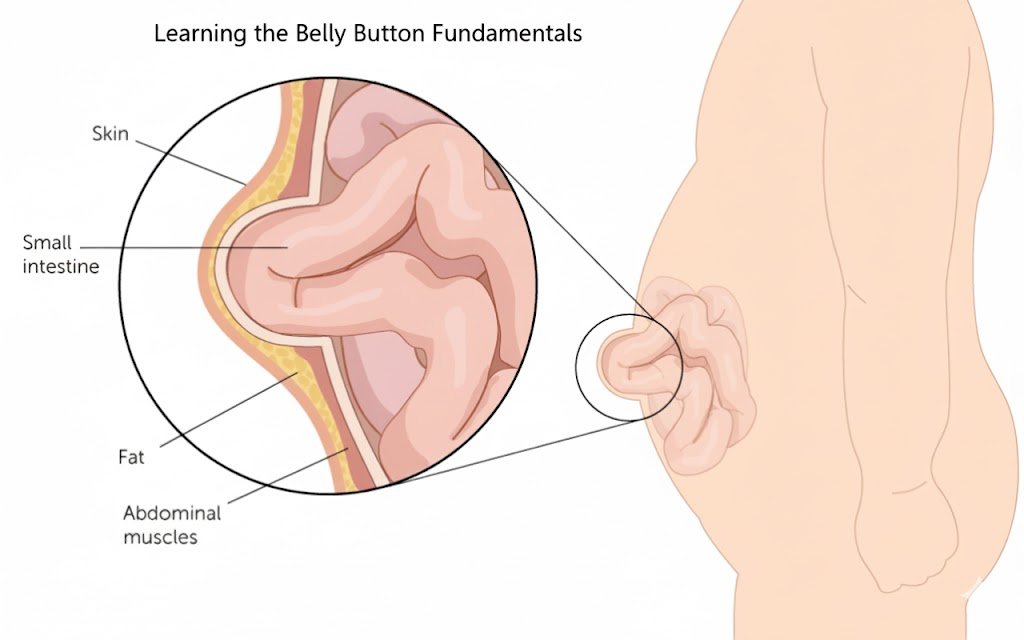
Prior to discussing outies in particular, it is worthy to comprehend what a belly button truly is. The belly button, or umbilicus, as the physicians refer to it, is a scar. Yes, it is so–the scar they left behind them, after they had cut your umbilical cord when you got born. You had the umbilical cord to the placenta of the mother which was your lifeline until you were born, and that was giving you all the oxygen and the nutrients you needed to grow.
At birth, the umbilical cord had to be clamped and cut down leaving a little stub in your belly. In the coming week or two, this stump dried and fell off leaving your belly button behind. The manner in which this healing process occurred among other factors, is what made you either an innie or an outie.
Why is a belly button an innie or an outie
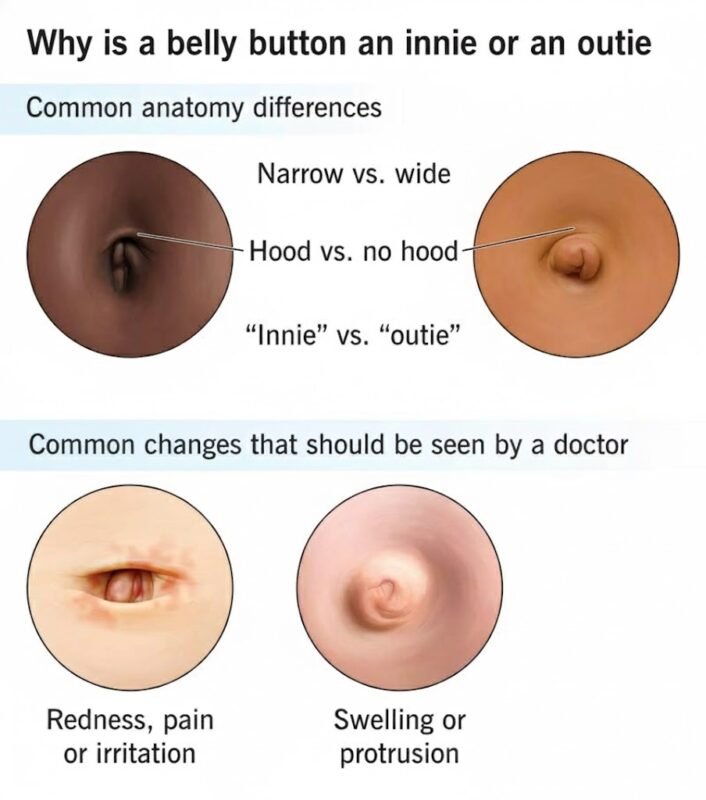
The form of the belly button relies on the manner in which the tissue recovered following the cutting off of the umbilical cord. A belly button is innie, which forms a small hole or depression of the stomach. An outie belly button, on the contrary, protrudes out of your stomach to a certain extent. This is slightly raised in some and more prominently in others, which are outies.
The major distinctions between the outies and the innies include:
The number of innie belly buttons is larger; they constitute approximately 90 percent of all belly buttons. They occur due to the umbilical ring closing and producing a small opening. The skin and tissue are forced back towards the wound healing up forming that familiar little shallow cavity.
Outies are not as frequent, featuring in approximately 10 percent of individuals. They develop in instances where there is a little bit of additional scar tissue, which develops or when the manner in which the umbilical ring closes makes the protrusion of the skin rather than to fold in.
The Real Reasons of Outie Belly Buttons.
At this point we want to establish the root of the question, or what is the actual cause of an outie belly button? This knowledge can assist you to draw the line between what is true and what is not in terms of belly button formation.
Natural Healing Effect and Scar Tissue.
Outie belly button is simply due to the healing process of your body following birth. The falling of the umbilical stump causes the body of each person to heal in a unique way. There are those babies who grow a little more scar tissue in that region such that the belly button would stick out rather than in. This is entirely normal and a normal variation of humans.
Consider it as any other scar on the body of yours, some of them are flat, some are raised, and some are hardly visible. You have the same thing with your belly button scar. How much and what form of scar tissue you developed during healing were major factors in whether or not you developed an innie or an outie.
Influencing factors on scar tissue formation:
- Umbilical cord thickness at birth.
The umbilical stump dried and fell off so fast.
Your personal healing feedback.
The biological properties of your body and skin.
Inheriting factors which determine healing.
The Size of Your Umbilical Ring
The second consideration is the volume of your umbilical ring. It is the hole in your stomach wall through which the umbilical cord was thrust during your time in the womb. This ring must seal itself up after birth as a healing process.
The umbilical ring is a bit larger in nature in some babies. A bigger ring may occasionally result in a tiny tissue protrusion which pushes outward giving an outie belly button. The ring could also be closed leaving some excess tissue bulging out.
Common belly button shapes
| Type | Description | How common |
|---|---|---|
| Innie | Curves inward | Very common |
| Outie | Sticks outward | Less common |
| Flat | Almost level with skin | Uncommon |
| Hooded | Skin folds over | Seen in some adults |
Why Some Belly Buttons Stick Out
An outie belly button usually forms because of how the skin and tissue heal after the umbilical cord falls off. It is not caused by how parents cared for the cord or how doctors cut it.
Main reasons for an outie belly button
- Extra skin left after the cord falls off
- Tissue pushing outward instead of pulling inward
- Healing patterns passed down in families
- Mild pressure from inside the abdomen during healing
A pediatric surgeon once explained in a medical journal that belly button shape is “mostly a matter of chance during healing rather than a sign of care quality or genetics alone.”
Healing differences that matter
| Healing factor | Effect on belly button |
|---|---|
| Thick scar tissue | More likely to push outward |
| Loose skin | Can form a raised shape |
| Tight skin | Often pulls inward |
| Uneven healing | Creates unique shapes |
Umbilical Granuloma
The belly button of a newborn may also appear like an outie though in this case it is known as umbilical granuloma. It is a tiny, wet, bright red mass of tissue which may develop in the Umbilical stump when it is dropped off. It occurs in a situation in which the area does not heal in the correct manner and begins to grow additional tissue.
Umbilical granulomas are typically small, the size of a pea and they are painless. Neither are they permanent like an actual outie belly button. They could be treated in a number of ways by doctors and once healed; the belly button tends to heal naturally. Unless the granuloma is treated, it can remain there and form an appearance of an outie.
Evidence of an umbilical granuloma:
Wet looking red tissue at belly button.
Minute lump with possible clear or yellowish fluid.
Pain, no pain, discomfort, none.
Abnormal tissue that appears dissimilar to normal skin.
Occurs in the initial few weeks of the cord shedding.
Baby’s Position and Movement
The activity of a baby and his/her position in the healing process may also contribute insignificantly. Although this is not a significant factor, it may have an effect on the way the tissue settles during healing. Crying or straining babies may exert additional pressure on the belly region and this may have an impact on the belly button healing.
But it is only a small fraction of the puzzle. A baby will not avoid an outie by being very quiet, and an active baby is not necessarily going to get an outie. It is one of the numerous little things that may make a slight difference.
Cosmetic Concerns and Choices
Some adults feel self-conscious about an outie belly button and look into cosmetic options. This is a personal choice and not medically required in most cases.
Non-surgical options
- Clothing styles that feel comfortable
- Body confidence counseling
- Fitness to strengthen core muscles
Surgical options
Belly button reshaping, sometimes called umbilicoplasty, is a cosmetic procedure. It changes the appearance of the navel.
Comparison of choices
| Option | Purpose | Considerations |
|---|---|---|
| Clothing choice | Comfort | Easy and safe |
| Fitness | Muscle support | Takes time |
| Surgery | Shape change | Cost and recovery |
What Does NOT an Outie Belly Button

Outie belly buttons are believed to be caused by a great number of myths. It is time to clear these misunderstandings.
The Biggest Myth- The Doctor Cut.
It is likely the most widespread myth:
people believe that the way the doctor or midwife cut or clamped the umbilical cord will make a baby an innie or an outie. This is simply not true. Doctors and nurses have the same practice of cutting the cords, and the method they adopt does not influence the shape of the belly button.
The umbilical cord is clamped at two points and between the clamps is chopped. This is so the same with every baby. What is really important is what follows afterwards- what is the progression in the following weeks and months of your body. The cutting does not even make it or break it whether you will have an innie or outie.
The reason that the cutting technique does not matter:
The practice is similar to all babies, with a basic procedure of clamping at a certain distance to the belly and cutting clean. The stump left is usually an inch in length. After that stump falls off on its own the body takes over. The innie or outie is not under the control of any doctor depending on his or her cutting process.
Pulling or Tugging the Cord
Other individuals feel that the umbilical cord can be pulled or tugged during birth hence resulting to an outie. This is another myth. This cord is planned to be rather strong and the belly button is not influenced by normal manipulations in the course of birth. And to add on to this, medical workers are trained to use the cord well hence no pulling and tugging which would affect how the belly button will be ultimately shaped.
How the Cord Was Tied
You may have older family members tell you that the cord was tied and this influenced belly button shape.
In contemporary medical practice, the cord is not bound with a piece of string as it used to be done in the olden days.
A plastic clamp is instead used. Yet even in the situation when the cord was tied according to the traditional methods this would not have led to an outie.
The tie or clamp is put on the stump that later dries up and falls off, it does not touch the part that becomes your real belly button.
What really occurs with clamping the cords:
The tie or the clamp is just a temporary one and lasts as long as the stump is pressed. When the stump drops off, whatever effect there was in the clamp is lost. What makes your belly button is the same tissue that is lying underneath, not anything external.
Things Parents Did or Did Not Do.
Parents occasionally fear that outie belly button of the baby was caused by something they or did not do. Perhaps, they did not clean it well, or were too rough when changing diapers or they allowed the baby to cry too much. All these do not result in outie belly buttons.
The umbilical stump can be taken care of by just meeting the general hygiene and care guidelines and doing what is right. The reason why an outie develops is due to the natural differences in healing and not due to parenting requirements.
Health Issues of the outie belly buttons.
Although the outie belly button is simply an ordinary variant of the belly button that does not pose any medical issue, other disorders can lead to the formation of an outie belly button or even be related to it. These are important to know because you will be able to know whether medical attention can be necessary.
The most common medical cause is umbilical Hernia.
The most popular medical cause of outie belly button is the umbilical hernia. This occurs when a piece of the intestine or fatty tissue causes a hole to develop in a sector of the abdominal wall along the belly button. What comes out is a bulge which may resemble an outie.
Umbilical hernias are in fact very common among babies particularly premature babies. They occur due to the fact that the passage the umbilical cord used to go through had not completely closed yet. Most umbilical hernias resolve on their own, with age, at three or four as the abdominal muscles tighten, and the baby grows.
Helping Children and Teens Feel Confident
Body confidence starts early. How adults talk about outie belly buttons can shape how young people feel about themselves.
Supportive ways to talk
- Use neutral language
- Avoid jokes or labels
- Encourage questions
- Share real facts
Confidence habits
| Habit | Effect |
|---|---|
| Positive body talk | Builds self-esteem |
| Role modeling | Sets example |
| Open discussion | Reduces fear |
| Respect differences | Encourages acceptance |
Counselors often note that normalizing body differences early can reduce anxiety later in life.
Final Thoughts
An outie belly button typically occurs due to natural healing following delivery, minor muscular variations or a prevalent medical condition such as an umbilical hernia. It is, in the majority of the cases, harmless and needs not treatment. The causes of this will be known, which can serve to decrease anxiety and instill confidence.
There are numerous varieties of bodies and belly buttons are not an exception. Comfort is much more important than the shape of the navel, observing strange symptoms, and the condition of health in general. Such a visible belly button with an easy attitude transforms into a normal aspect of human diversity.