
Blog
Double Jointed Elbows: Causes, Symptoms, and Prevention

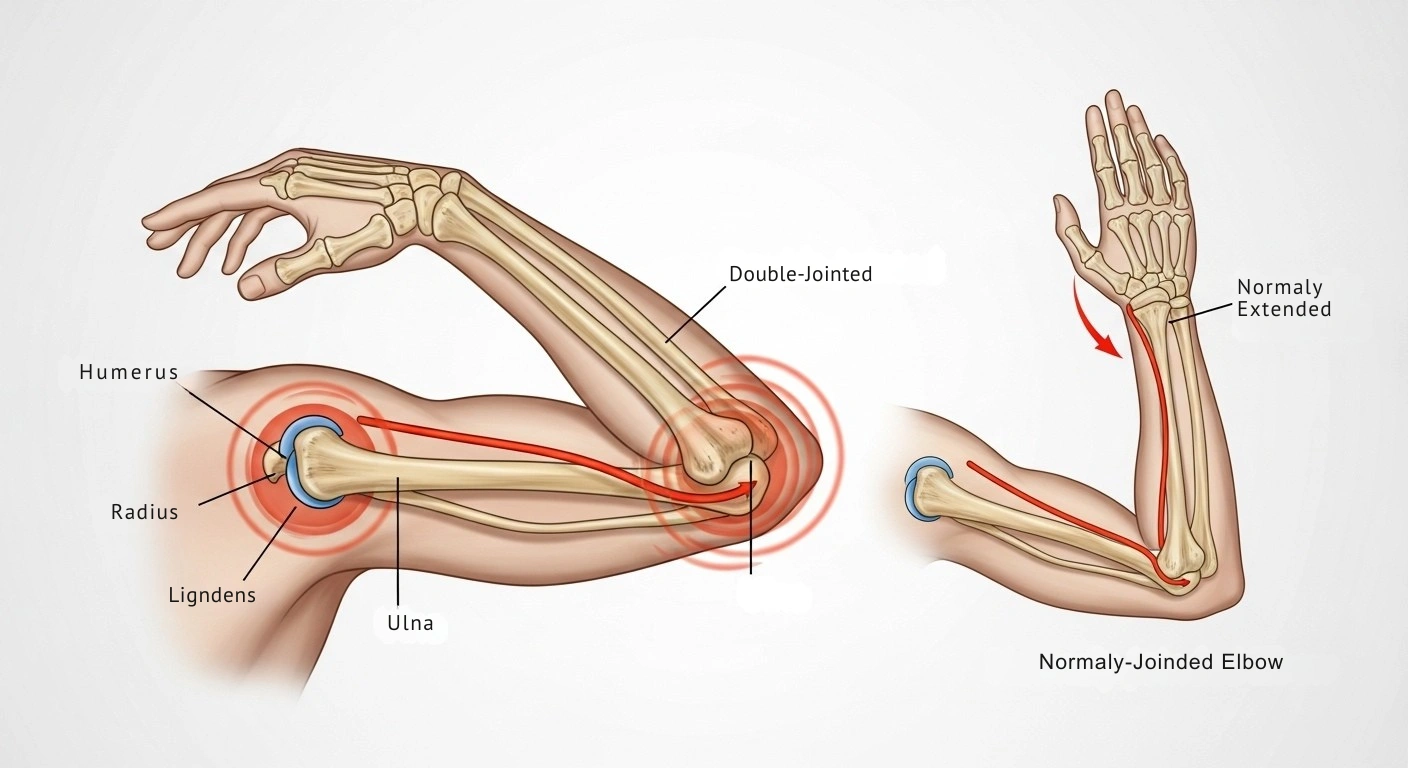
Have you ever watched someone bend their elbow the wrong way and felt a mix of amazement and mild horror? You are not alone. Double jointed elbows are one of those things that look like a circus trick but are actually a pretty common part of human biology.
Here is the truth. “Double jointed” is not even a real medical term. Nobody has extra joints hiding in their arms. What people actually have is a condition called joint hypermobility, where the elbow can move beyond the normal range of motion. It might seem like a cool party trick, but it comes with a surprisingly complex story involving genetics, connective tissue, hormones, pain, and injury risk.
What Exactly Are Double Joint Elbows?
The term “double jointed” has stuck around because it sounds like it explains the phenomenon. But nobody actually has two joints in one place. It simply means your elbow bends further than most people’s does.
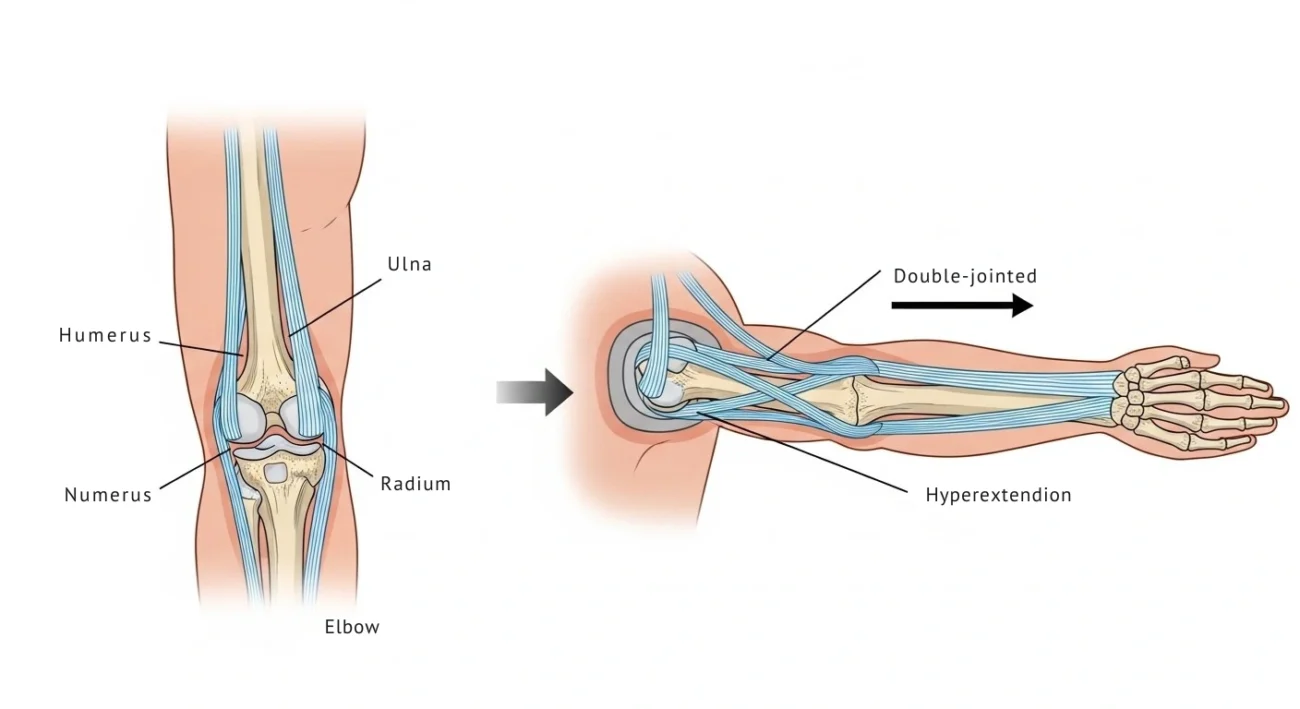
In medical terms, this is called elbow hypermobility. The elbow is a hinge joint that connects the humerus, which is the upper arm bone, to the radius and ulna, which are the two forearm bones. A normal elbow straightens to about 180 degrees. A hypermobile elbow goes beyond that and often hyperextends 10 degrees or more past the standard range.
So what makes this possible? The ligaments that hold the joint together are more lax or elastic than usual, and that gives the joint extra room to move. Think of a rubber band that has been stretched too many times. It still works, but it does not snap back with the same tightness it once had.
Research suggests that 17.2 percent of school-aged children show signs of hypermobility in at least one joint. Some studies put the general population figure as high as 40 percent depending on how the condition is classified. So if your elbows bend a little further than your friends’ do, you are far from alone.
What Causes Double Joint Elbows?
Genetics It Often Runs in the Family:
The number one driver of elbow hypermobility is genetics. If your parents had flexible joints, there is a good chance you inherited that same trait. Hypermobility runs in families because it is rooted in how the body builds and maintains collagen, which is the structural protein that makes up ligaments, tendons, and skin.
When collagen is more lax or stretchy than normal, the ligaments around joints allow a greater range of movement. This does not mean something is broken. It simply means the body’s structural scaffolding is built a little differently from most people’s.
Connective Tissue Disorder:
Sometimes double jointed elbows are one piece of a much larger puzzle. The most commonly associated conditions include:
- Hypermobile Ehlers-Danlos Syndrome (hEDS): This is a genetic connective tissue disorder where collagen problems affect multiple body systems. People with hEDS often deal with hypermobility in many joints alongside stretchy skin, chronic pain, and fatigue. Elbow hyperextension beyond 10 degrees is part of the Beighton diagnostic criteria used to assess hEDS.
- Hypermobility Spectrum Disorder (HSD): This is a broader category for people with symptomatic hypermobility who do not fully meet the criteria for hEDS. It causes the same range of joint-related symptoms.
- Joint Hypermobility Syndrome (JHS): This term is sometimes used interchangeably with HSD. It describes generalized hypermobility that comes along with pain or other symptoms.
- Rarer conditions: Marfan syndrome, Loeys-Dietz syndrome, and osteogenesis imperfecta can also involve joint hypermobility as a feature.
Hormonal Factor:
Research suggests that hormonal fluctuations, particularly changes in estrogen levels, can increase joint laxity in people who are already predisposed to hypermobility. This is something most articles on this topic simply skip over, but it matters a great deal.
During puberty, pregnancy, and the days leading up to a period, estrogen levels shift in ways that can make ligaments even looser than usual. This is one of the main reasons joint hypermobility is diagnosed far more often in females than in males.
Pregnancy is especially worth noting. The hormone relaxin, which the body produces to loosen the pelvis for childbirth, actually affects joints throughout the entire body, including the elbows. For women who already have hypermobility, this can noticeably increase instability and discomfort during and after pregnancy.
Occupation and Physical Activity:
Athletes, dancers, musicians, and people whose jobs involve repeated elbow bending or twisting may develop isolated elbow hypermobility. This means the flexibility shows up mainly in that one joint rather than across the whole body. Gymnasts and swimmers are particularly prone to this because of the demands placed on their upper limbs day after day.
Symptoms of Double Joint Elbow
Unusual Range of Motion:
The most visible symptom is the ability to bend or straighten the elbow further than most people can. If your elbow extends more than 10 degrees beyond a straight line, that counts as hyperextension. Some people can bend their elbow backward quite dramatically, which tends to alarm anyone nearby who is not expecting it.
Joint Instability and the Wobbly Feeling:
Loose ligaments do not just allow extra movement. They also reduce stability. Many people with hypermobile elbows describe a wobbly sensation where the joint does not feel properly supported during normal activities. Common signs of instability include:
- A sense that the elbow might give way during everyday tasks
- Frequent clicking, popping, or grinding sensations in the joint
- Difficulty maintaining a steady grip
- The arm tiring faster than it should during light activities
The Subluxation and Dislocation Cycle:
This is something that does not get nearly enough attention. When a hypermobile elbow partially slips out of position, which is called a subluxation, it does not just cause immediate pain. It starts a damaging cycle. Each subluxation stretches the already lax ligaments a little further, which makes the next one more likely to happen. Over time, a joint that occasionally slips can become one that slips frequently, and that makes everyday tasks genuinely difficult.
This is exactly why addressing elbow instability early matters so much rather than waiting for things to get worse.
Pain and Aching:
Pain is one of the most common symptoms of elbow hypermobility, and it often surprises people who assume flexible joints should feel perfectly fine. The pain can range from a dull ache after activity to sharp, persistent discomfort even at rest. It typically comes from:
- Ligaments being repeatedly overstretched beyond their comfortable range
- Muscles working overtime to compensate for poor joint stability
- Inflammation building up around the joint over time
Tennis Elbow and Golfer Elbow:
Hypermobile elbows are more prone to overuse injuries. The two most common ones are:
- Lateral epicondylitis, known as tennis elbow: This is pain on the outer side of the elbow involving tendons that attach to the lateral epicondyle of the humerus.
- Medial epicondylitis, known as golfer’s elbow: This is pain on the inner side of the elbow that affects the flexor muscles of the forearm.
Even mild repetitive movements can trigger these conditions faster in hypermobile individuals than in people with typical joint stability.
Central Nervous System Overstimulation:
In people with chronic hypermobility, the nervous system can become overly sensitized over time. This is known as central sensitization, and what it means in practice is that the brain starts amplifying pain signals even when actual tissue damage is minimal. It can show up as:
- Pain that feels out of proportion to the activity that caused it
- Widespread aching that is not confined to one joint
- A sense of being easily overwhelmed by physical sensations
- An exhausting cycle where pain causes stress and stress then worsens the pain
Understanding this connection matters because managing hypermobile elbows is not just about the joint itself. It also involves looking after the nervous system.
Difficulty with Weight-Bearing Activities:
Locking out a hypermobile elbow places all the stress on the passive structures of the joint, meaning the ligaments and cartilage, instead of the active ones, meaning the muscles. Over time, this strains the joint, compresses nearby nerves, and can throw both the shoulder and wrist out of alignment. Activities like planks, push-ups, yoga poses, and lifting heavy objects all carry a higher risk for people who have hypermobile elbows.
Brain-Body Communication Problem:
Hypermobile joints often suffer from something called proprioceptive dysfunction. This is a breakdown in communication between the joint and the brain. The brain receives inaccurate information about where the elbow is and how it is positioned, which makes it harder to judge angles, anticipate stress, or react quickly to sudden movements. In everyday life this shows up as clumsiness, slower reaction times, and a tendency to accidentally overextend the elbow without meaning to.
Muscle Fatigue and Imbalance:
When ligaments cannot properly stabilize the joint, the surrounding muscles have to take over that job. They end up working much harder than they normally would, and over time this leads to:
- Faster muscle fatigue during tasks that should feel easy
- Soreness that develops without any obvious cause
- Muscle imbalances that affect posture and upper body mechanics
- General tiredness that feels out of proportion to what was actually done
Long-Term Complications
Early Joint Degeneration:
The cartilage in a hypermobile elbow faces more stress and unusual loading patterns than a typical joint does. Over time this accelerates wear and can lead to early-onset osteoarthritis. This is a condition most people do not associate with younger people, but it appears more frequently in those who live with chronic joint hypermobility.
Chronic Pain Syndromes:
Unmanaged hypermobility can develop into chronic pain that spreads well beyond the elbow. People with hEDS or HSD may develop widespread musculoskeletal pain, nerve sensitivity, and a nervous system that stays in a state of heightened alert long after the original trigger has passed.
Secondary Effects on the Shoulder and Wrist:
Because the elbow sits between the shoulder and the wrist, instability in this joint creates a chain reaction. Poor elbow mechanics can throw off shoulder alignment, contribute to neck pain, and overload the wrist, turning one unstable joint into a cascade of problems across the entire upper limb.
Psychological Impact:
Living with chronic pain, unpredictable dislocations, and physical limitations takes a real toll on mental health. Anxiety, depression, and social isolation are all more common in people with connective tissue hypermobility disorders. This side of the condition is often underaddressed in standard medical care, and it deserves more attention.
How Are Double Joint Elbows Diagnose?
The Beighton Score:
The most widely used tool for assessing generalized joint hypermobility is the Beighton Score, which is a 9-point scale that tests flexibility in several joints. Two of those points relate directly to the elbows, one point per arm. A score of 4 or more, combined with joint pain in four or more areas for at least three months, may indicate joint hypermobility syndrome.
The five movements that are tested include:
- Bending forward to place both palms flat on the floor without bending the knees
- Bending each elbow backward past straight, scoring one point for each arm
- Bending each knee backward, scoring one point for each leg
- Bending each thumb back to touch the forearm, one point per hand
- Bending each little finger backward past 90 degrees, one point per hand
It is worth knowing that the Beighton Score has real limitations. It mainly captures widespread hypermobility and can easily miss cases where only the elbows are affected. A good clinician will always look at the full clinical picture alongside the score rather than relying on the number alone.
Additional Diagnostic:
A thorough diagnosis may also include:
- X-rays or imaging to check for structural damage
- Blood tests to rule out other causes like rheumatoid arthritis
- The Brighton Criteria, which is a more comprehensive diagnostic framework used when joint hypermobility syndrome is suspected
Prevention and Management
Strengthening the Surrounding Muscles:
Since hypermobility cannot be cured, the most effective approach is building strong muscles around the elbow to compensate for lax ligaments. Isometric exercises, which contract muscles without moving the joint, are especially useful because they build stability without risking overextension. A solid program includes:
- Wrist curls and reverse wrist curls with light resistance
- Forearm pronation and supination exercises
- Resistance band work for the biceps and triceps
- Grip-strengthening with a soft ball or therapy putty
Avoiding the Elbow Lock:
Learning not to lock the elbow is one of the simplest and most impactful habits to develop. Keeping a soft micro-bend during all activities keeps the muscles engaged and takes stress off the ligaments and cartilage. This one change alone can make a meaningful difference in how the elbow feels throughout the day.
Low-Impact Exercise:
Staying active matters, but the type of activity makes all the difference. Good choices for hypermobile individuals include:
- Swimming, ideally with a kickboard to avoid elbow hyperextension in the water
- Cycling on an ergonomic setup
- Pilates and tai chi
- Walking and gentle yoga with careful attention to arm positions
High-impact activities and anything involving heavy lifting or forceful elbow extension should be approached with real caution.
Proprioception Training:
Because hypermobile elbows often come with poor joint position awareness, targeted exercises to retrain the brain’s sense of the joint are genuinely helpful. These include:
- Slow resistance movements done in front of a mirror
- Single-arm balance and stability work
- Controlled range-of-motion exercises guided by a physiotherapist
The goal is to help the brain build a clearer and more accurate picture of where the elbow is in space at any given moment.
Bracing and Support:
An elbow brace can provide temporary stability during high-risk activities or while recovering from an injury. It works best as a short-term protective tool. Long-term reliance on a brace can actually weaken the surrounding muscles over time, which is the opposite of what is needed.
Professional Support:
Working with a physiotherapist or occupational therapist who understands hypermobility can make a real difference. A good therapist will:
- Design a personalized strengthening and stabilization program
- Teach movement modifications for everyday tasks
- Address proprioceptive problems with targeted training
- Help adapt activities like writing, carrying, or lifting to reduce joint strain
Pain Management Options:
For persistent discomfort, the available options include:
- NSAIDs for short-term pain relief
- Topical anti-inflammatory creams applied directly to the elbow
- Steroid injections during acute flare-ups
- Low-dose tricyclic antidepressants or gabapentin for nerve-related or centrally sensitized pain
- Muscle relaxers for painful spasms around the joint
- Surgery as an absolute last resort when structural repair is genuinely necessary
Nutrition for Joint Health
Diet alone will not fix loose ligaments, but good nutrition genuinely supports connective tissue health over time. Key nutrients worth prioritizing include:
- Vitamin C: Essential for collagen synthesis and a healthy immune response
- Magnesium: Supports muscle relaxation and reduces cramping around unstable joints
- Omega-3 fatty acids: Found in oily fish, walnuts, and flaxseed, these help reduce joint inflammation
- Protein: The building block of all connective tissue, and adequate intake supports daily repair
- Zinc and copper: Both play a role in collagen production and tissue maintenance
Keeping a healthy body weight also reduces the mechanical load placed on every joint, including the elbows, which adds up to a meaningful difference over time.
Final Thoughts
Double jointed elbows are far more common than most people realize, and they exist on a wide spectrum from a harmless quirk to a daily challenge that needs active management. The good news is that with the right knowledge, consistent strengthening habits, and a little extra awareness around hormones and sleep, most people with hypermobile elbows can live full, active, and comfortable lives. Stop ignoring the signs, start building strength around those joints, and do not be afraid to ask for professional support when you need it. Your elbows work hard for you every single day, and they are well worth looking after.