
Blog
Veneajelu – The Finnish Tradition of Boat Rides on Lakes

There’s a moment every first-time visitor to Finland talks about. It’s not the Northern Lights. It’s not the sauna. It’s that quiet afternoon when someone hands you a pair of oars, points at a shimmering lake, and says “just go.” No destination, no itinerary, no rush. Just you, a wooden boat, and water so clear you can see the rocks ten feet below.
That experience has a name veneajelu and once you’ve felt it, a part of you never really comes back to shore.
Veneajelu (pronounced VEH-neh-AY-eh-loo) is the Finnish tradition of taking slow, easy boat rides across lakes, rivers, and coastal waters. The word itself is simple: “vene” means boat, and “ajelu” means ride. But like most things in Finland, the simplicity on the surface hides something surprisingly deep underneath.
This isn’t a tourist gimmick or an extreme sport. Veneajelu is a living piece of Finnish culture, one that has shaped how Finns think about time, nature, family, and happiness for thousands of years. In this guide, we cover it all the history, the meaning, the best places, the seasons, the wellness side, the fishing traditions, the legal basics, and everything you need to plan your own experience.
The Deep Roots: Where Veneajelu Actually Come From
Finland isn’t just a country with lots of lakes. Finland is the lakes. With nearly 188,000 lakes and one of the longest coastlines in Europe, water isn’t background scenery here. It’s the main character of the whole country.
Before roads and railways existed, Finland’s waterways were the highways that connected communities, moved trade goods, and fed families through long winters. The earliest roots of veneajelu go back to the Sami and ancient Finnish peoples, who built handmade wooden boats to travel the vast interior lake networks. These weren’t leisure trips at all. They were lifelines.
By the medieval period, boats were Finland’s primary transportation network. Over the centuries, as roads slowly appeared, the boat changed from a necessity into something richer a place of joy, quiet thinking, and real belonging.
What’s genuinely interesting is that this shift from survival tool to cultural treasure happened on its own. Nobody planned it or announced it. Finns kept rowing not because they had to, but because they wanted to. And somewhere in that simple choice, veneajelu was born.
What is Veneajelu
Here what travel brochures always miss: veneajelu isn’t really about the boat. It’s about what happens to you when you’re sitting in it.
Picture a Tuesday evening in July. The Finnish sun doesn’t set until close to midnight, so the light at 9 PM is warm and golden in a way that photographers spend their whole careers chasing. You’re in a small wooden rowboat on Lake Päijänne. The water is perfectly still. No engine sound anywhere. The only noise is the soft rhythm of oars and a loon calling from somewhere far off in the reeds.
Your phone has been in your pocket for two hours and you haven’t thought about it once.
That’s veneajelu. Finns have a deep, comfortable ease with silence that’s almost impossible to explain to outsiders. On the lake, silence isn’t awkward or empty. It feels full. It’s made of trees, water, wind, and your own breathing. This is what veneajelu gives you, and it’s genuinely hard to find anywhere else in the modern world.
The Role of the Mökki: Where Veneajelu Truly Live
You can’t really understand veneajelu without understanding the Finnish summer cottage the mökki. Finland has roughly 500,000 summer cottages, which works out to about one for every ten people in the country. Nearly every single one of them has a boat sitting by the water.
The mökki and the boat are inseparable. The ritual plays out the same way across the country: arrive Friday evening, heat the sauna, swim in the lake, grill sausages, and then as the evening light turns golden take the boat out. Maybe you row to a nearby island. Maybe you just drift in the middle of the lake and watch the pine reflections. Maybe you bring a thermos of coffee and sit in comfortable silence with someone you love.
Kids in Finland often learn to handle a rowboat before they ever learn to ride a bicycle. Nobody formally teaches them. It’s just something absorbed through years of summer weekends on the lake. Grandparents pass it down to grandchildren, and along with the skill comes something more important a whole way of being in the world.
Types of Veneajelu: Find the Style That Suits You
Veneajelu doesn’t ask for special skills, big budgets, or expensive gear. There’s a genuine version of it for everyone.
The Traditional Rowboat (Soutuveneet):
This is the heart and soul of veneajelu. Finnish wooden rowboats often handcrafted and passed from parent to child offer the quietest, most meditative time on the water. When you’re rowing, you face backward, so you literally cannot rush toward a destination even if you wanted to. You just move slowly and rhythmically while the world opens up behind you. Perfect for early mornings, quiet evenings, and anyone who wants to actually think for once.
The Motorboat (Moottorivene):
The practical choice for Finland’s bigger lake systems, where islands sit kilometers apart. Motorboats let you cover real distance, carry more people, and reach swimming spots that would take half a day by oar. Most rental companies in Finland don’t need a boating license for smaller engines, which makes them easy for visitors to use.
The Sailboat (Purjevene):
Sailing adds craft and a bit of strategy to the whole experience. The coastal regions and bigger lakes attract enthusiasts who mix veneajelu’s quiet spirit with the gentle thrill of reading the wind. Finland has a proud sailing tradition, especially around the southwestern archipelago.
Kayaks and Canoes:
For solo travelers or anyone wanting something more active, kayaking and canoeing offers an intimate, close-to-the-water veneajelu experience. Kolovesi National Park is especially well known for this silent paddling past ancient rock paintings in near-total wilderness.
Electric Boats:
The fastest-growing choice right now. Electric boats give you the silence of a rowboat combined with the range of a motorboat. They’ve quickly become the preferred option for Finns who care about keeping their waterways clean and quiet.
The Floating Sauna (Saunalautta):
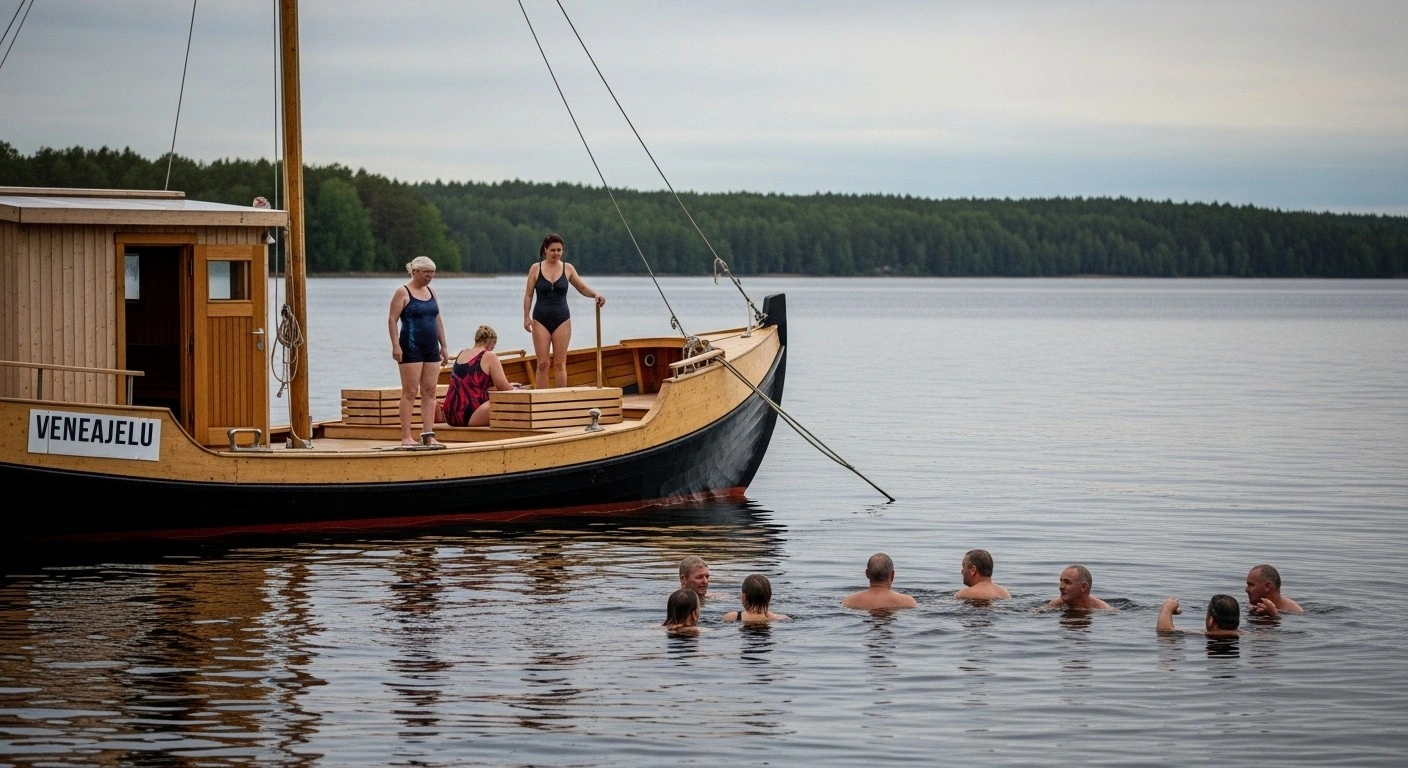
This one deserves its own space because it is wonderfully, completely Finnish. A saunalautta is a proper sauna cabin built onto a floating platform. You heat the sauna while drifting across the lake, step outside and jump into cool water when you need to cool down, then climb back in and do it all over again. You can rent them by the hour in Helsinki, Tampere, and Jyväskylä. If veneajelu and sauna are Finland’s two most beloved experiences, the floating sauna is what happens when someone decided there was absolutely no reason to choose between them.
Traditional Food and Drink That Complete the Experience
Food and veneajelu are closely connected. Most articles skip this topic almost entirely, and that’s a real shame, because the food culture around a Finnish boat ride is genuinely one of its best parts.
Coffee (Kahvi) The Sacred Thermos:
Finns drink more coffee per person than almost any other nation on Earth, and no veneajelu feels right without a thermos of strong, dark kahvi. The tradition usually goes like this: anchor near a rocky shore or a small island, pull out the thermos, and sit in quiet company while the coffee does its work. Some families bring a small camp stove and brew fresh coffee right there on the boat a ritual that feels far more meaningful than it has any right to.
Smoked Fish (Savustettu Kala):
Finland’s lakes are packed with pike, perch, zander, and vendace. Smoked fish is one of the great simple pleasures of Finnish food, and many veneajelu trips include freshly smoked fish served on rye bread (ruisleipä) with butter and dill. It’s the kind of lunch that makes you genuinely wonder how you ever ate any other way.
Grilled Sausages (Makkara):
The Finnish love of grilling sausages over an open fire is almost spiritual in its seriousness. Finland’s national parks maintain thousands of designated fire pit islands around the country for exactly this purpose. Makkara grilled over birch wood and eaten with mustard (sinappi) is the unofficial food of the entire Finnish summer.
Berry Pastries and Pulla:
Fresh blueberries, cloudberries, and lingonberries grow wild all across Finland through the summer months. Berry pastries and sweet pulla soft cardamom buns are classic boat snacks. They taste noticeably better when eaten outside on the water, and that’s not just the fresh air talking.
Mölkky The Shore Game Everyone Plays
When a veneajelu outing stops at an island, a game of mölkky almost always follows. Mölkky is a Finnish throwing game where players toss a wooden pin at numbered wooden skittles, trying to score exactly 50 points. It sounds simple until you’re one point away from winning and suddenly throw a zero. It creates more genuine laughter and good-natured arguments than almost any game you’ll come across. Playing mölkky on a lakeside island, in golden evening light, with smoked fish and coffee nearby that’s not just a game. That’s a proper memory.
The Best Place in Finland for Veneajelu
Finland has so much water that choosing where to go honestly feels a little overwhelming at first. Here’s a straight, practical breakdown of the best spots.
Lake Saimaa:
Finland’s largest lake system not really a single lake at all, but a wide, sprawling network of waterways, bays, islands, and narrow channels across southeastern Finland. You could boat here every day for a year and never repeat the same route.
The star of Saimaa is the Saimaa ringed seal one of the rarest freshwater seals on Earth, found nowhere else in the world. Spotting one from a silent rowboat is one of those experiences that stays with you for a very long time.
Turku Archipelago — An Island World
Over 20,000 islands scattered across southwestern Finland. Island-hopping by motorboat, stopping at small fishing villages for fresh fish soup and thick archipelago bread, is a purely Finnish way to spend a summer week.
Lake Päijänne — The Long Blue Highway
Finland’s second-largest lake, stretching 120 kilometers through central Finland. Long, narrow, with forested ridges on both sides, crystal-clear water, and quiet small towns along the shores ideal for multi-day houseboat trips with no particular hurry.
Kolovesi National Park — Where Silence Is the Whole Point
Motorboats are strictly restricted here. The park runs as a near-total silence zone, best explored by canoe or kayak. Ancient Sami rock paintings sit along some of the shores, which adds a real layer of historical depth to an already remarkable place.
Helsinki Archipelago — Urban Veneajelu
Helsinki sits among more than 300 islands, and the city’s harbor offers some of the most genuinely beautiful urban waterways anywhere in the world. Canal cruises pass the Suomenlinna Sea Fortress (a UNESCO World Heritage Site), thread through narrow island channels, and open out into the Baltic. It’s proof that veneajelu doesn’t need a remote rural lake. It just needs water and a willingness to slow down.
Åland Islands — The Maritime Soul
Sitting between Finland and Sweden in the Baltic Sea, the Åland Islands carry a unique Finnish-Swedish culture. Veneajelu here feels coastal and salty red granite cliffs, small busy harbors, and wind-shaped pines that look like they’ve been standing there since before anyone was counting.
Veneajelu Across the Seasons
Summer (June to August) — The Golden Time
Finland’s Midnight Sun means the sun barely sets at midsummer, turning a late evening boat ride into something genuinely hard to describe. The light is long and golden, the water is warm enough to swim in, and the whole lake feels like it belongs to a different, quieter world. Juhannus Finland’s Midsummer celebration is built almost entirely around lakes, bonfires, and boats.
Autumn (September to October) — The Secret Season
The Finnish concept of ruska describes the turning of autumn colors across the forests. Lakeshores shift into a wide tapestry of red, orange, copper, and gold. The crowds are gone, the light goes soft and a little melancholy, and honestly, every photograph looks like it was edited when it wasn’t. September is veneajelu at its most beautiful and its least crowded.
Spring (April to May) — The Awakening
The first boat rides after the ice thaws feel like a small celebration. The water is cold, the forests are that bright, electric new green, and you’ll likely have the whole lake to yourself. It’s a raw, quieter version of the experience made for people who genuinely love solitude.
Winter — The Brave Option
Rare but real. A few coastal routes offer icebreaker-assisted cruises, and some ice hotels organize lake experiences in the deep cold. Mostly though, winter is when the boats get put away and Finns spend their evenings planning where they’ll go in summer.
Veneajelu and Your Mental Health: The Science Behind the Magic
This isn’t just poetic framing the research behind it is solid and worth knowing.
Studies on blue spaces (water environments) consistently show they have a stronger positive effect on mental health than green spaces like parks or forests, which themselves already reduce stress significantly. The water’s reflective surface, its calming sound, the open horizon, and the gentle rocking motion of a boat together create what researchers call effortless attention restoration. Your brain actually gets to rest without you having to try.
The Finnish Institute for Health and Welfare found that just 15 minutes in nature measurably lowers cortisol, which is the body’s main stress hormone. Add the rhythm of rowing and the absence of screens, and you have something that genuinely works like therapy — without the waiting list.
The sensory simplicity plays a big role too:
- You hear water, wind, and birdsong nothing competing with anything else
- You see open sky, forest, and its mirror image in still water
- You feel the slow rocking of the hull beneath you
- You smell pine trees, lake water, and genuinely clean air
- You taste coffee that somehow tastes better out here than it ever does at home
This kind of quiet gives an overstimulated mind real space to breathe. It’s why so many people come off their first veneajelu not just feeling relaxed, but feeling like something got reset.
The Art of Veneajelu Fishing: A Tradition Within a Tradition
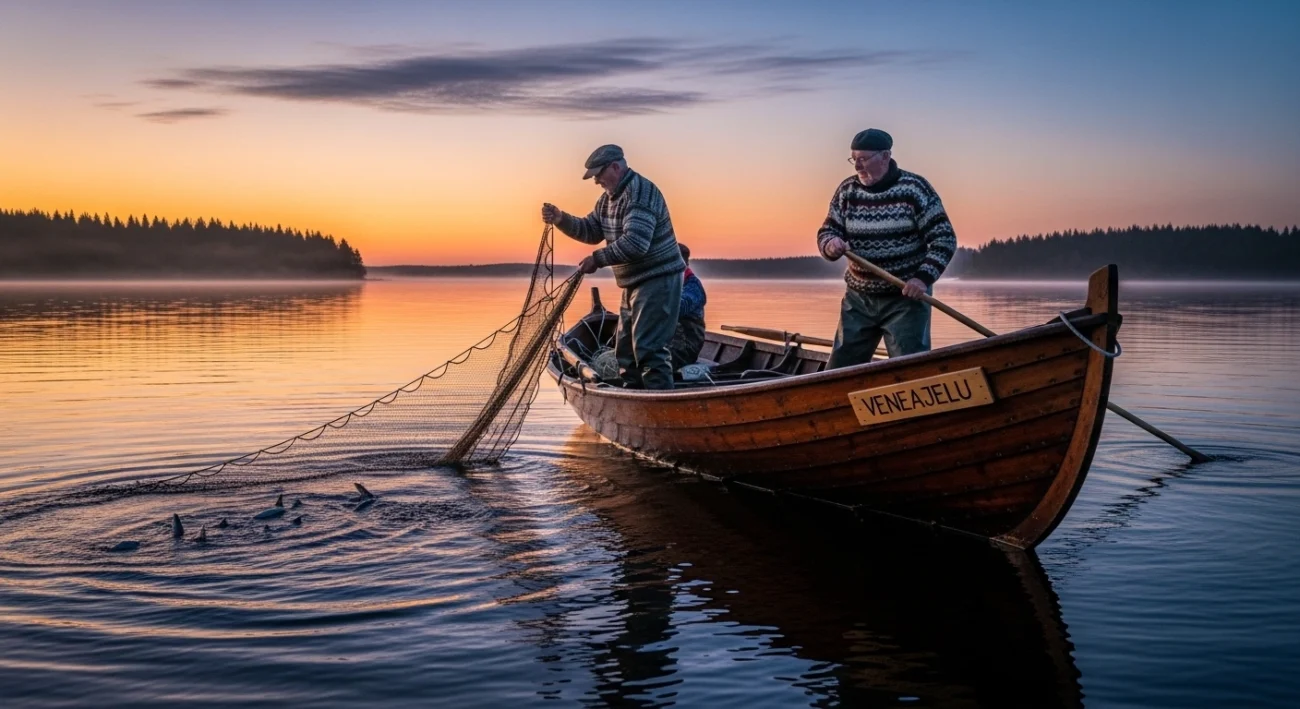
No other article on this topic gives fishing the space it deserves, and that’s a genuine gap because for a large number of Finnish families, fishing and boat riding aren’t two separate activities. They’re one and the same thing.
Fishing as Meditation:
Finnish lake fishing from a small rowboat is one of the most meditative things a person can do. You cast your line, you wait, and you watch the water. There’s no rushing it and no way to force it. The fish decides when it bites, and until then, you are simply sitting on the lake being present. Finns describe this kind of enforced patience as deeply restorative, and it fits completely within the broader spirit of veneajelu.
What Finns Fish For:
Finland’s lakes carry an extraordinary variety of freshwater fish. The most commonly targeted species on a typical veneajelu fishing trip include:
- Pike (hauki) — valued for its size and the fight it puts up
- Perch (ahven) — mild, sweet-tasting, and easy enough for beginners to catch
- Zander (kuha) — widely considered the finest-eating freshwater fish in Finland
- Vendace (muikku) — small silvery fish, fried whole as a snack, and somehow tasting far better than their size suggests
The Everyman Right to Fish
This surprises almost every visitor: in Finland, everyone has the right to fish with a rod and line in almost any body of water, regardless of who owns the land. This comes from Finland’s ancient jokamiehenoikeus, which translates as Everyman’s Right. You need an affordable national fishing license, bought online in a few minutes, but you generally don’t need permission from the landowner. Finland’s waters belong, in some honest and fundamental sense, to everyone who’s standing near them.
Cooking What You Catch
Many veneajelu fishing trips end with the catch being cooked right there on the shore. Fresh perch cleaned and grilled over a small open fire, eaten on rye bread with butter while you sit on a lakeside rock — this meal has been eaten in Finland for thousands of years. It needs almost no cooking skill, uses nothing that wasn’t already there, and delivers a satisfaction that no restaurant honestly comes close to.
Finnish Boating Laws Every Visitor Should Know
This section doesn’t appear in any other veneajelu article online, which is genuinely strange because it’s some of the most practically useful information a visitor can have before renting a boat in Finland.
The Alcohol Limit on Water
The legal blood alcohol limit for operating a motorized vessel in Finland is 0.5 per mille the same as driving a car. The coast guard does patrol Finnish waters, and violations are taken seriously.
- If you’re steering the motorboat, you’re not drinking
- Passengers can enjoy a beer or two without any issue
- Small rowboats work under slightly different rules, but being sensible on the water is always the right call
Right of Way on Finnish Waters
Finnish boating law follows international maritime rules adapted for inland use:
- Sailing vessels have right of way over motorboats
- A vessel being overtaken has the right of way
- Boats approaching from the starboard (right) side generally go first
In practice, Finnish lakes are calm and uncrowded enough that serious conflicts rarely come up. But knowing the basics helps you feel confident and behave respectfully around other boats.
Speed Limits Near Shore
- Motorboats must stay at around 5 knots (roughly 9 km/h) within 150 meters of shore
- Lower limits apply in national parks and other protected areas
- These rules protect shorelines from wake erosion and preserve exactly the kind of peace that makes Finnish lakes worth visiting
Everyman’s Right (Jokamiehenoikeus) on Water
Finland’s ancient Everyman’s Right extends to the water in some genuinely generous ways. Here’s what you can and can’t do:
You can:
- Row, paddle, or sail freely across any body of water
- Anchor temporarily near any shore
- Swim from any waterfront
- Pick up natural materials that wash ashore
You cannot:
- Operate a motorboat in restricted or protected zones
- Disturb nesting birds or wildlife
- Leave any waste behind, of any kind
- Light fires on private land without the owner’s permission
These rights and limits together form a kind of social agreement around Finnish nature — use it freely, treat it gently, and leave it exactly as you found it.
Navigation and Charts
The Finnish Transport Infrastructure Agency (Väylä) provides free digital navigation charts through public apps. Always check the marked fairways before taking a motorboat into unfamiliar archipelago waters. Finland’s waterway marking system is very good clear buoys and well-maintained navigation aids exist even on remote and quiet lakes.
How to Experience Veneajelu as a Visitor
Choosing Your Location
For anyone doing this for the first time, calm inland lakes are a much better starting point than coastal routes. The open Baltic can get rough and unpredictable even on sunny days. Lake Saimaa, Päijänne, and the lakes around Tampere all have good boat rental options and beginner-friendly water.
Renting vs. Guided Tours
Renting gives you total freedom rowboats and small motorboats are affordable, widely available, and need no license for smaller engines. You go where you want, stop when you want, and stay out as long as you feel like it.
Guided tours give you context, stories, and local knowledge you’d never find on your own. They’re especially worth it in Helsinki or the Turku Archipelago, where the history and culture around the water adds enormous depth to the whole experience.
What to Pack
A few things that make a real difference on any veneajelu outing:
- A waterproof jacket (Finnish weather changes fast, even mid-summer)
- A thermos of coffee and some food for the water
- Sunscreen (the reflection off the water amplifies UV more than most people expect)
- A dry bag for your phone, wallet, and camera
- Your phone fully charged with offline maps downloaded
- A life jacket for every single person on board
Safety First
- Check the Finnish Meteorological Institute forecast before heading out always
- Tell someone on shore your route and when you plan to be back
- Stay close to marked fairways if you’re new to the waterway
- Keep life jackets easy to grab at all times, and on children at all times
Veneajelu in the Modern Age: The Tradition Keeps Moving
Electric boats are the biggest single shift happening right now. They offer the silence of a rowboat with the practical range of a motorboat, and they’ve become the natural choice for Finns who love their lakes too much to leave a noisy, oily wake across them.
Digital navigation apps have genuinely changed how people plan veneajelu trips. Free government charts, live weather updates, and route planners make it easy to explore even remote lake networks without stress.
New experiences have grown up around the old tradition too, including:
- Guided wildlife photography tours on the water
- Culinary cruises focused on local fresh fish and seasonal ingredients
- Floating sauna (saunalautta) rental packages for groups
- Themed island picnic tours with local food producers
- Veneajelu trips combined with yoga or wellness retreats on the water
What hasn’t changed, through any of this, is the spirit. Whether you’re in a century-old wooden rowboat at sunset or a whisper-quiet electric boat threading through Helsinki’s outer islands, the core truth of veneajelu stays exactly the same. Slow down. Pay attention. Let the water do what it’s been doing here long before you arrived.
Final Thoughts
Veneajelu is one of those rare experiences that doesn’t need to be dramatic to stay with you. A simple wooden boat, a quiet lake, good coffee in a thermos, and an hour with no particular plan that really is the whole thing. And somehow, that’s more than enough. In a world that constantly pulls at your attention from every direction, the Finnish tradition of the boat ride quietly makes a different kind of offer. It says: here’s some water, here’s some sky, here’s some silence. Do whatever you want with it. Most people who take that offer up come back changed in ways they can’t quite explain a little slower, a little more present, and genuinely wondering why they don’t live more of their life this way.