
Blog
Songoftruth org: Expert Parenting Tips & Child Development

The foundation of a Songoftruth org is based on a single assumption: the parents and their children develop best when calm words, constant actions, and sincere feelings meet. As the yoga discipline requires breath, posture and concentration in bringing balance, parenting similarly requires patience, rhythm and care. This concept of a Song of Truth is formulated in this guide as a gentle song which the parents are able to compose and sing in the yoga or quiet time. This is not a song that is all about music ability. It concerns voice, emotion, and stable words that make the body relax and the mind safe.
The concept of child development which honors age and growth.
Meditative yoga sessions that parents can practice day in day out.
These concepts are effective among parents who are fatigued, hurried or uncertain. Yoga poses that parents are encouraged to sing or talk a soothing song will make them go slow. Children are calmed by this and tend to be more attentive and less aggressive.
A gentle idea behind Song of Truth and mindful parenting
- Voice has a calming effect on the nervous system
- Repeated words create safety and trust for children
- Simple body movement supports emotional balance
| Element | How it helps parents | How it helps children |
|---|---|---|
| Calm voice | Reduces stress | Builds emotional safety |
| Steady breath | Improves focus | Encourages calm behavior |
| Honest words | Builds confidence | Supports trust and bonding |
Why creating your own song during yoga supports parenting
Body awareness and emotional care are well interrelated when parents sing or speak soft lines when doing yoga. The practice makes parents overcome anger and act reasonably, instead of being angry and throwing a tantrum. Children learn by watching. Their observation of smooth movement and reception of monotonous words imitates this behaviour in the long run.
Yoga slows the body. A simple song slows the mind. They also assist the parents in their presence even in the time of difficulty such as tantrums, bedtime opposition or school stress.
Modifications that parents are experiencing benefits:
Improved emotion regulation in conflict.
Better tolerance to repetition.
Closer bond during quiet time together.
Examples of simple song lines parents can create:
- “I breathe in calm, I breathe out tight thoughts”
- “My body is steady, my heart is kind”
- “I stand strong and soft at the same time”
Ways to use this song:
- During early morning yoga
- While stretching before bedtime
- During short breaks when emotions feel heavy
| Yoga moment | Song focus | Parenting benefit |
|---|---|---|
| Morning stretch | Energy and clarity | Better mood for the day |
| Evening pose | Safety and rest | Easier bedtime routine |
| Stress pause | Patience and breath | Calmer reactions |
Simple yoga words that match natural movement
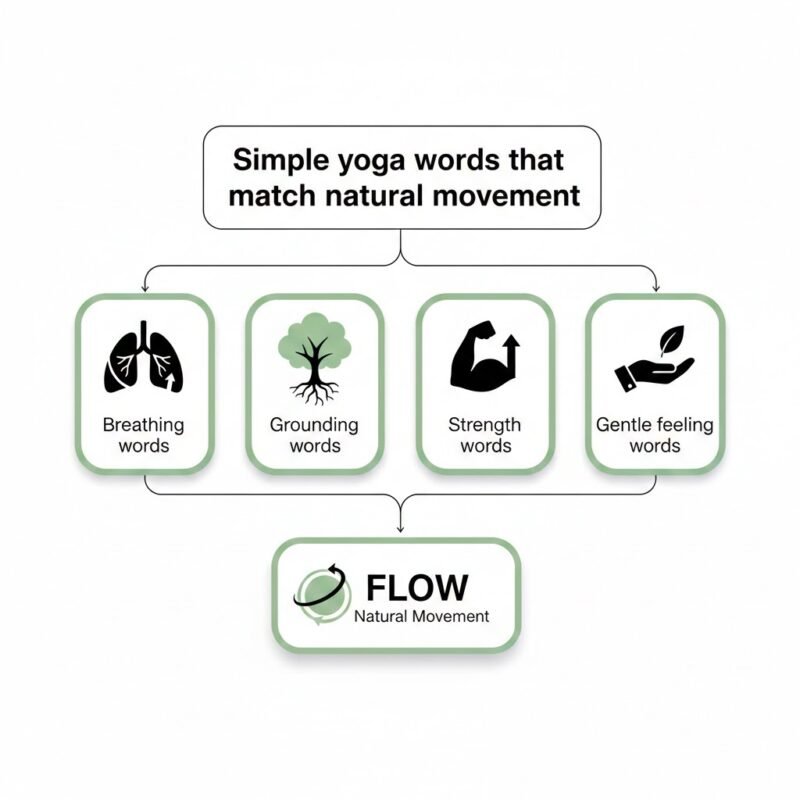
The yoga language does not have to sound complicated. The most excellent words are plain and slow. Simple phrases are easier to comprehend to children, and parents can easily remember. The Song of Truth employs words that are associated with body motion, breathing, and emotions.
Useful word themes include:
Breathing words
Grounding words
Strength words
Gentle feeling words
Words that are accommodating of yoga:
Breathe, rise, soften, stay
Strong legs, calm hands
Quiet mind, open heart
The parents are able to talk or sing these words in a monotonous manner. The goal is not performance. The goal is feeling.
| Word type | Sample words | Effect |
|---|---|---|
| Breath words | In, out, slow | Calms nervous system |
| Body words | Stand, bend, rest | Improves awareness |
| Feeling words | Safe, kind, steady | Builds emotional balance |
Standing poses and songs that build strength and patience
Standing poses help parents feel grounded. When the body feels stable, emotions often follow. These poses work well with songs focused on strength, balance, and calm effort.
During a standing pose, parents can repeat short lines aloud or silently. The voice helps keep focus and prevents the mind from racing.
Sample standing song lines:
- “My feet are firm, I stay calm”
- “I hold my ground with care”
- “I am steady, I am here”
Parenting lessons from standing poses:
- Stay present during difficult moments
- Hold boundaries with kindness
- Remain calm even when challenged
| Standing pose feeling | Song message | Parenting meaning |
|---|---|---|
| Strong legs | I stand with care | Clear boundaries |
| Open chest | I stay kind | Emotional warmth |
| Balanced weight | I stay steady | Consistent parenting |
Forward bends and songs for rest and release
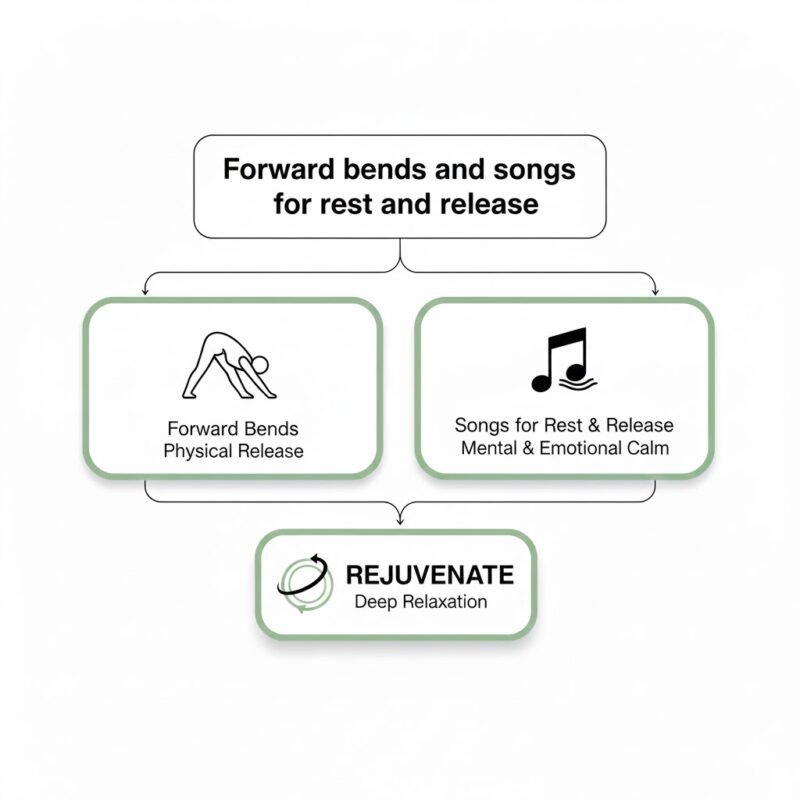
Forward bends help release tension in the back and neck. These areas often hold stress from daily parenting tasks. A quiet song during these poses supports rest and emotional release.
These moments are helpful after long days or emotional strain. The song should be slower and softer than in standing poses.
Gentle song ideas:
- “I let go, I feel safe”
- “My breath moves slow and easy”
- “I rest without worry”
Parenting lessons from forward bends:
- Let go of guilt
- Accept imperfection
- Allow rest without judgment
| Forward bend focus | Song theme | Emotional result |
|---|---|---|
| Relaxed spine | Letting go | Reduced tension |
| Slow breath | Safety | Emotional comfort |
| Stillness | Acceptance | Better self-care |
Seated poses and songs that support listening and focus
Seated yoga poses encourage stillness and attention. These poses work well for songs about listening, understanding, and calm presence. Parents who practice this regularly report better communication with their children.
Simple seated song lines:
- “I listen with care”
- “I pause before I speak”
- “I hear what matters”
These lines help parents respond thoughtfully instead of reacting quickly.
Parenting benefits:
- Better listening during emotional talks
- Clearer communication
- Reduced misunderstandings
| Seated practice | Song message | Parenting skill |
|---|---|---|
| Upright posture | I stay present | Focus |
| Calm hands | I wait and hear | Patience |
| Even breath | I choose my words | Clear speech |
Balance poses and songs that teach flexibility in parenting
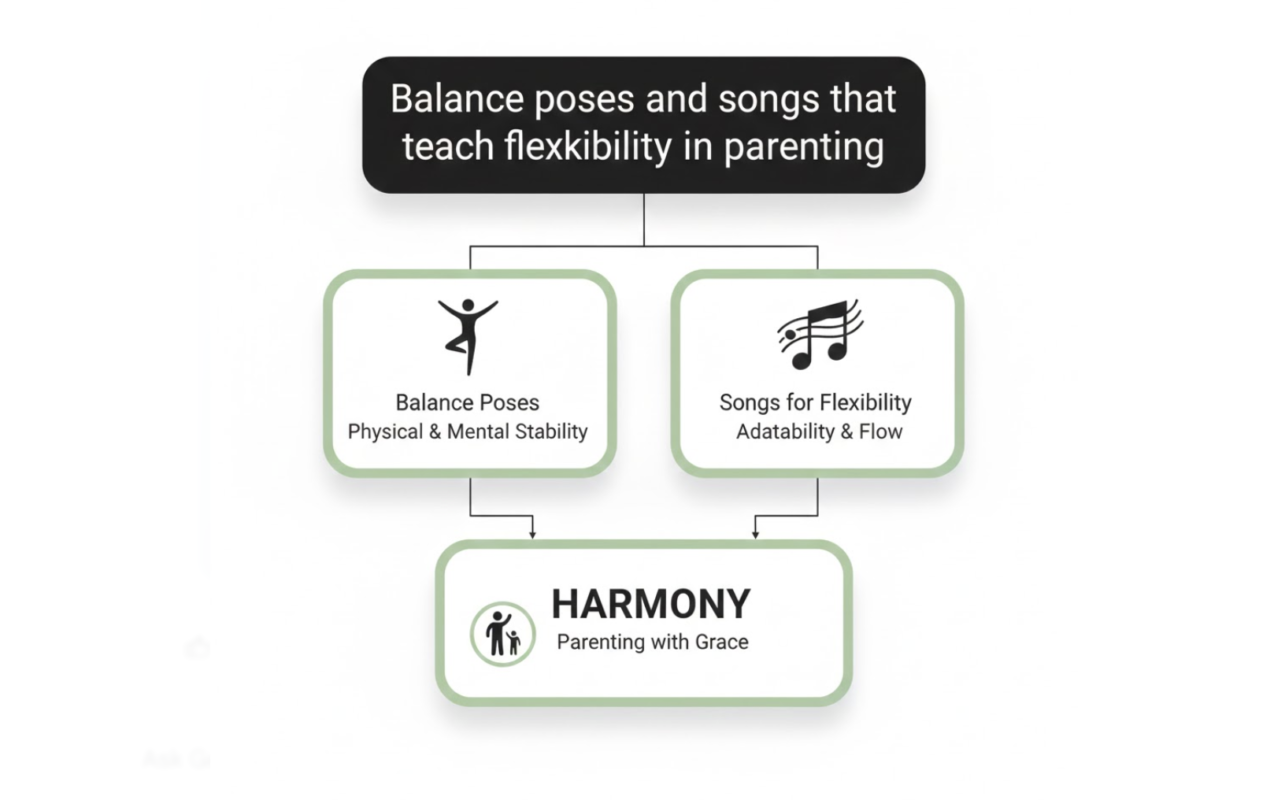
Balance poses are useful reminders that parenting requires adjustment. These poses teach parents how to recover calmly when things do not go as planned.
During balance poses, songs can focus on effort without pressure.
Helpful song lines:
- “I wobble and return”
- “I try again with care”
- “I stay calm when I shift”
- Mistakes are part of growth
- Flexibility builds trust
- Calm recovery teaches children resilience
| Balance challenge | Song focus | Life lesson |
|---|---|---|
| Losing balance | Try again | Growth mindset |
| Shaking muscles | Stay gentle | Self-kindness |
| Regaining pose | Calm effort | Emotional recovery |
Lying poses and songs for safety and emotional repair
Lying poses allow full rest. These poses are ideal for songs focused on safety, care, and reassurance. Parents can use these songs before sleep or after difficult parenting moments.
- “I am safe, my child is safe”
- “I rest and trust”
- “The day is done, I breathe”
- Emotional repair after conflict
- Better sleep
- Reduced worry
| Lying pose moment | Song feeling | Parenting result |
|---|---|---|
| Full rest | Safety | Emotional healing |
| Closed eyes | Trust | Better sleep |
| Slow breath | Calm | Reduced anxiety |
Using Song of Truth with children during shared yoga
Children enjoy movement paired with sound. Parents can invite children to join simple poses and repeat easy lines. This builds connection and supports emotional learning.
Tips for shared practice:
- Keep poses simple
- Use short phrases
- Allow playful movement
Examples of child-friendly song lines:
- “We breathe in, we breathe out”
- “Strong legs, soft smiles”
- “We rest and feel calm”
| Child age | Pose type | Song style |
|---|---|---|
| Toddlers | Sitting and lying | Short and playful |
| Young kids | Standing and balance | Rhythmic and clear |
| Older kids | Mixed poses | Calm and steady |
Expert insight on voice, movement, and child development
Dr. Lena Morris, a child development researcher, notes:
“Repeated calm speech paired with steady movement helps regulate both adult and child nervous systems. This kind of practice supports emotional safety and trust.”
This insight supports the Song of Truth method. When parents model calm voice and movement, children learn emotional regulation through observation.
- Children mirror emotional tone
- Voice rhythm supports focus
- Predictable routines build security
| Research focus | Practical result |
|---|---|
| Calm tone | Reduced stress |
| Repetition | Emotional safety |
| Shared practice | Stronger bonding |
Creating your own Song of Truth at home
Parents do not need music training. The best songs are personal and honest. Choose words that reflect your values and current needs.
Steps to create a simple song:
- Pick a feeling you want to support
- Choose three to five clear words
- Match the words to breath and movement
- Patience during busy mornings
- Calm before bedtime
- Strength during challenges
| Feeling goal | Sample words |
|---|---|
| Patience | Slow, wait, kind |
| Calm | Breathe, soft, safe |
| Strength | Stand, steady, strong |
Final thoughts
Songoftruth org is a simple and easy-going direction of the parents who prefer not to be pressured to choose. With the help of simple yoga motions and sincerity of words, parents may cultivate emotional stamina, better communication and greater trust in their children.
Such a strategy acknowledges the needs of adults and children. It advocates growth by practicing rather than perfection. The Song of Truth is not an object of learning. One should revisit it, revise it again and again attentively. Children are safe when their parents remain relaxed. With soft words, learning will occur naturally. This is the core of Songoftruth org and its way of mastering of parenting and child development advice you can depend on.
Our Research based References
- The Whole-Brain Child: 12 Revolutionary Strategies to Nurture Your Child’s Developing Mind by Siegel, D. J., & Bryson, T. P. (2014)
- Mechanisms of Mindfulness by Shapiro, S. L., Carlson, L. E., Astin, J. A., & Freedman, B. (2006)
- Effects of Mindful Awareness Practices on Executive Function in Children by Flook, L., Smalley, S. L., Kitil, M. J., et al. (2010)
- Maternal Meta-Emotion Philosophy and Adolescent Depressive Symptomatology by Katz, L. F., & Hunter, E. C. (2007)
- Meta-Emotion: How Families Communicate Emotionally by Gottman, J. M., Katz, L. F., & Hooven, C. (1997)
- Parent-Infant Synchrony and the Construction of Shared Timing; Physiological Effects by Feldman, R. (2013)
- Mindfulness and Health: Mechanisms and Evidence by Black, D. S., & Slavich, G. M. (2016)
- Interventions Shown to Aid Executive Function Development in Children by Diamond, A., & Lee, K. (2011)
- Full Catastrophe Living: Using the Wisdom of Your Body and Mind to Face Stress, Pain, and Illness by Kabat-Zinn, J. (1990)
- Executive Function and Theory of Mind in Early Childhood by Hughes, C., & Ensor, R. (2007)